
Graphic Design
Character icon design for an interactive board game, built from a modular feature system across six unique roles.
One Night Werewolf
Graphic Design
Six characters, one village, and a killer hiding in plain sight.
The Project
One Night Werewolf is an interactive board game featuring six main characters. It tells a story of magic and tragedy, where the characters work together to uncover the identity of the evil werewolf, while the werewolf attempts to conceal their true identity. With roles like the Seer, the Witch, and the Hunter, no two games are ever the same.

Six characters needed distinct, readable identities that could hold up as small icons while still feeling like part of one cohesive village.
Before any illustration began, each character's mechanics and personality traits were mapped out: the Werewolf (evil, dark, deceptive, manipulative), the Hunter (fearless, vengeful, unpredictable, marked by a scar), the Seer (insightful, protective, vulnerable, defined by a third eye), the Healer (tactical, secretive, protective), the Witch (powerful, ambiguous, defined by her potions), and the Villager (innocent, collective, observant). Mapping personality to mechanics first made sure every visual choice had a reason behind it.

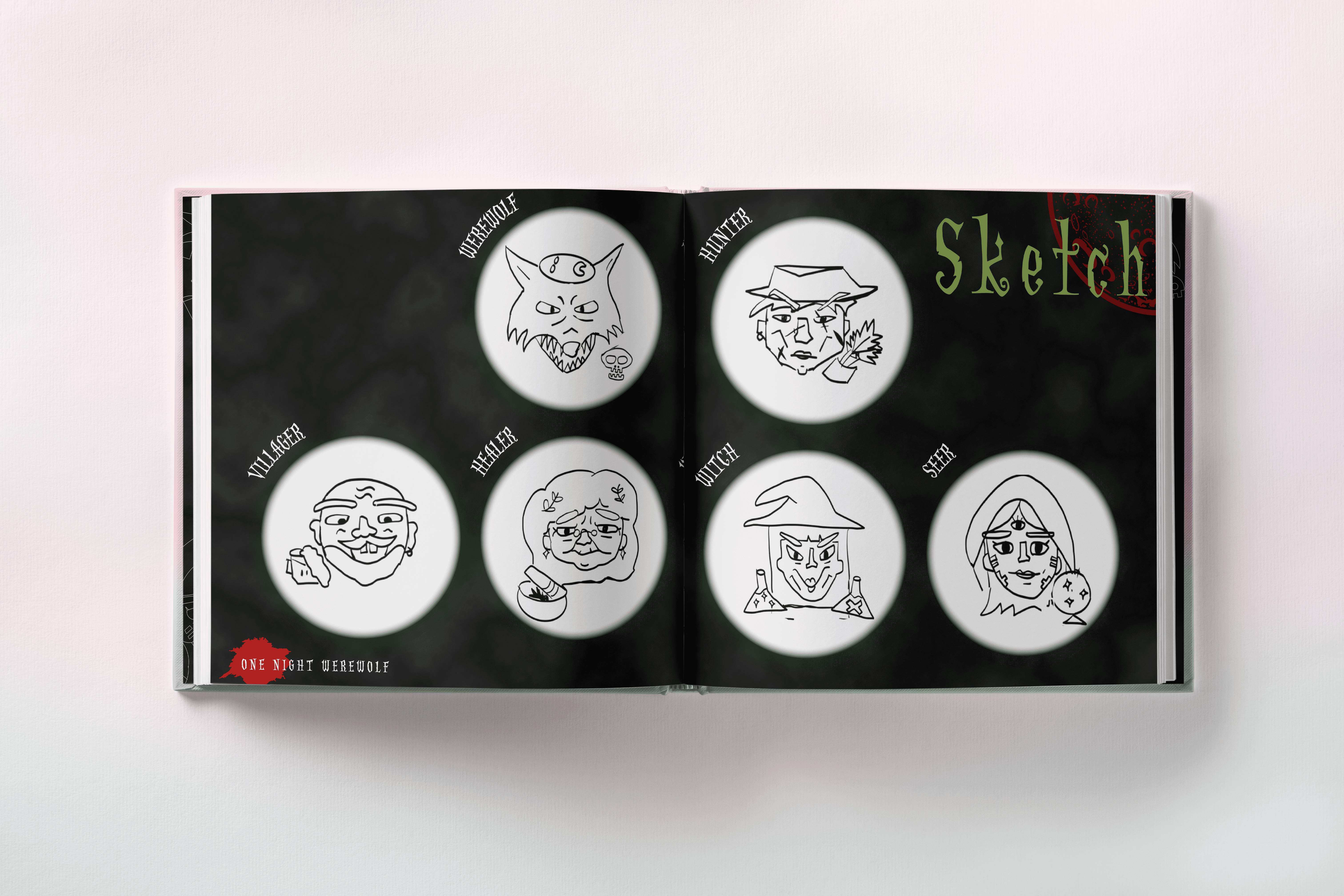
A modular system of eyebrows, eyes, noses, and tools let each character feel distinct while staying part of one consistent family.
Character development moved from rough pencil sketches into a modular icon feature system — a shared set of eyebrows, eyes, noses, and tools that could be mixed and matched to give each character a distinct expression while keeping the whole set visually consistent. The Werewolf's sharp brows and bared teeth read as immediately threatening, while the Healer's soft green palette and mortar and pestle signal safety at a glance.

Six final character icons, each readable at a glance and ready to anchor a full round of the game.
The final set of six icons balances warmth and menace across the cast: a snarling Werewolf, a scarred Hunter, an all-seeing Seer, a poison-brewing Witch, a gentle Healer, and a good-natured Villager. Built to read clearly at the scale of a single card, each character had to communicate its role instantly through color, expression, and a couple of well-chosen props.

More Works


Graphic Design
Character icon design for an interactive board game, built from a modular feature system across six unique roles.
One Night Werewolf
Graphic Design
Six characters, one village, and a killer hiding in plain sight.
The Project
One Night Werewolf is an interactive board game featuring six main characters. It tells a story of magic and tragedy, where the characters work together to uncover the identity of the evil werewolf, while the werewolf attempts to conceal their true identity. With roles like the Seer, the Witch, and the Hunter, no two games are ever the same.
Six characters needed distinct, readable identities that could hold up as small icons while still feeling like part of one cohesive village.
Before any illustration began, each character's mechanics and personality traits were mapped out: the Werewolf (evil, dark, deceptive, manipulative), the Hunter (fearless, vengeful, unpredictable, marked by a scar), the Seer (insightful, protective, vulnerable, defined by a third eye), the Healer (tactical, secretive, protective), the Witch (powerful, ambiguous, defined by her potions), and the Villager (innocent, collective, observant). Mapping personality to mechanics first made sure every visual choice had a reason behind it.
A modular system of eyebrows, eyes, noses, and tools let each character feel distinct while staying part of one consistent family.
Character development moved from rough pencil sketches into a modular icon feature system — a shared set of eyebrows, eyes, noses, and tools that could be mixed and matched to give each character a distinct expression while keeping the whole set visually consistent. The Werewolf's sharp brows and bared teeth read as immediately threatening, while the Healer's soft green palette and mortar and pestle signal safety at a glance.
Six final character icons, each readable at a glance and ready to anchor a full round of the game.
The final set of six icons balances warmth and menace across the cast: a snarling Werewolf, a scarred Hunter, an all-seeing Seer, a poison-brewing Witch, a gentle Healer, and a good-natured Villager. Built to read clearly at the scale of a single card, each character had to communicate its role instantly through color, expression, and a couple of well-chosen props.
More Works
Graphic Design
Character icon design for an interactive board game, built from a modular feature system across six unique roles.
One Night Werewolf
Graphic Design
Six characters, one village, and a killer hiding in plain sight.
The Project
One Night Werewolf is an interactive board game featuring six main characters. It tells a story of magic and tragedy, where the characters work together to uncover the identity of the evil werewolf, while the werewolf attempts to conceal their true identity. With roles like the Seer, the Witch, and the Hunter, no two games are ever the same.
Six characters needed distinct, readable identities that could hold up as small icons while still feeling like part of one cohesive village.
Before any illustration began, each character's mechanics and personality traits were mapped out: the Werewolf (evil, dark, deceptive, manipulative), the Hunter (fearless, vengeful, unpredictable, marked by a scar), the Seer (insightful, protective, vulnerable, defined by a third eye), the Healer (tactical, secretive, protective), the Witch (powerful, ambiguous, defined by her potions), and the Villager (innocent, collective, observant). Mapping personality to mechanics first made sure every visual choice had a reason behind it.
A modular system of eyebrows, eyes, noses, and tools let each character feel distinct while staying part of one consistent family.
Character development moved from rough pencil sketches into a modular icon feature system — a shared set of eyebrows, eyes, noses, and tools that could be mixed and matched to give each character a distinct expression while keeping the whole set visually consistent. The Werewolf's sharp brows and bared teeth read as immediately threatening, while the Healer's soft green palette and mortar and pestle signal safety at a glance.
Six final character icons, each readable at a glance and ready to anchor a full round of the game.
The final set of six icons balances warmth and menace across the cast: a snarling Werewolf, a scarred Hunter, an all-seeing Seer, a poison-brewing Witch, a gentle Healer, and a good-natured Villager. Built to read clearly at the scale of a single card, each character had to communicate its role instantly through color, expression, and a couple of well-chosen props.
More Works